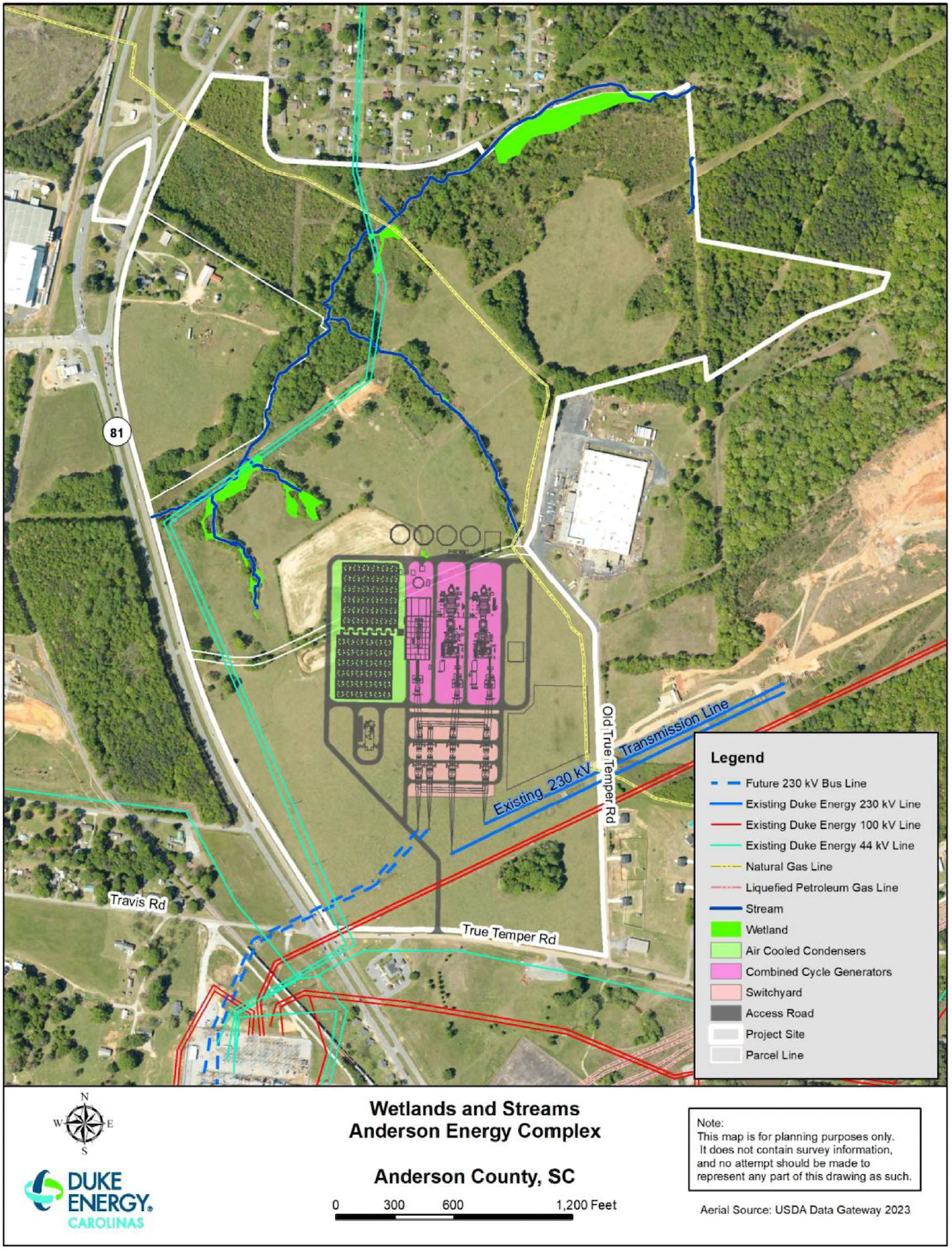
Duke Energy has received approval from the Public Service Commission (PSC) to construct a 1,365-megawatt combined-cycle gas power plant on nearly 200 acres of undeveloped land in Anderson County, with streams and wetlands, and in close proximity to homes, schools and city limits.
The project includes:
Two gas turbine generators
Two heat recovery steam generators
One steam turbine generator
The estimated cost of the project is $3.2 billion.
Figure 3.7.4: Streams and Wetlands from Duke Energy's Environmental Report. Click here to see additional site maps.
What Stage Is the Project In?
Although the PSC approved Duke Energy’s application to construct the plant in March 2026, the project still needs several additional permits and approvals before it can move forward.
On September 11, the South Carolina Department of Environmental Services (DES) issued a draft air permit for the proposed plant. That permit will determine what air pollution Duke Energy can emit and what requirements it must meet to monitor and control those emissions.
Air pollution is one of the community’s primary concerns. The proposed facility would add a new major source of industrial emissions near homes, schools and Anderson city limits. A strong permit must include public health protections, clear pollution limits and robust monitoring to ensure Duke Energy complies.
Take Action
DES has scheduled a public hearing on the draft air permit for Tuesday, October 13. Ahead of the hearing, SCELP, Conservation Voters of South Carolina, Sierra Club and Upstate Forever are hosting a webinar about Duke Energy’s proposed air permit, what it would allow, why strong monitoring matters and how you can make your voice heard.
Join the Advocacy Training Webinar Tuesday, September 29, 2026 12:00 pm Register here
Attend the Public Hearing Tuesday, October 13, 2026 Q&A Session at 5:30 pm Public Hearing at 6:30 pm McFalls Landing at 1625 Broadway Lake Rd. in Anderson
Written and verbal comments will be accepted. Pre-registration is encouraged. DES’ full public notice can be found here.
Can’t attend the public hearing? Written comments will be accepted through October 20. Email yours to: AirPNComments@des.sc.gov with permit number PSD-50000026 v 1.0 in the subject line.
We also encourage you to email or call your county councilor with your concerns. Their contact information can be found here.
Your voice matters, and you do not need to be an expert to participate. When speaking or writing, focus on what matters most to you and your community. The points below are offered as guidance. You can use one, several or adapt them to reflect your own concerns.
Air pollution & community health
The proposed combined-cycle gas plant would be a major new source of air pollution in Anderson County. SCDES should ensure the air permit is as protective as possible for nearby residents.
The plant would expose the surrounding community to fine particulate matter and other harmful air pollutants. Fine particulate matter is a harmful form of air pollution linked to adverse health outcomes such as respiratory and cardiovascular illnesses, asthma, and increased risk of heart attack, stroke and cancer.
The proposed site is located in an area with high population density, near neighborhoods, elementary schools, places of worship and Anderson city limits. People who live, work, learn and worship nearby deserve protection from industrial emissions.
The area is already burdened by pollution and health stressors. SCDES should consider cumulative impacts, not just the pollution expected from this facility in isolation.
Duke Energy should be required to use strong pollution-control measures and comply with clear, enforceable emission limits.
The permit should require robust, transparent air-pollution monitoring so nearby residents and regulators can verify whether Duke Energy is meeting its permit requirements. Monitoring data should be publicly available, understandable and promptly reported.
Other Concerns
Environmental impacts
The combined-cycle gas plant is proposed for a greenfield site in Anderson County with many precious natural features, including a stretch of Beaver Creek and its associated wetlands, which connect downstream to Rocky River and Lake Secession.
Even if these streams and wetlands are not directly filled or rerouted, which could become necessary during construction, they will be disturbed by the siting and construction of this project.
Streams and wetlands are extremely important resources that contribute to water quality, filtration of pollutants and resilience in the face of more extreme weather events.
Decisions about where to locate major energy infrastructure should prioritize avoiding sensitive natural areas whenever possible, especially when alternative sites or energy strategies exist.
The proposed facility will require water for its operation, yet critical details remain unclear, including how much water will be used, where it will be sourced and what contingency plans are in place if air-cooling systems fail.
Nearly 85% of the Upper Savannah River Basin’s surface water is already permitted or registered for other uses, raising serious questions about cumulative strain on local water supplies.
Cost and energy implications
Fee-in-lieu-of-tax (FILOT) agreements are meant to benefit the public when a project's advantages outweigh its costs. Over 40 years, the proposed tax incentives would cost the county $2.59 billion in lost revenue – money that could otherwise support schools, roads and emergency services.
The project is estimated to cost $3.2 billion, which will likely be passed on to Duke Energy ratepayers, who are already experiencing rising energy bills.
The long-term financial risks of locking customers into decades of gas power infrastructure deserve careful scrutiny, particularly as cleaner, less costly alternatives exist and continue to advance.
Growth pressure and land-use change
Placing a combined-cycle gas plant in this area could permanently change the rural character of Anderson County.
Large energy facilities rarely stand alone. They drive the expansion of heavy industrial uses, paving the way for data centers and other energy-intensive developments that increase pollution, strain infrastructure, and reshape communities.
As green spaces continue to disappear across the Upstate, we thank you for standing up for this one!
SCELP's Role
The South Carolina Environmental Law Project provides legal expertise and advocacy to ensure that major infrastructure decisions comply with state law and protect communities and nature. We will continue to monitor this proposal closely and work alongside partners to uphold strong environmental standards.